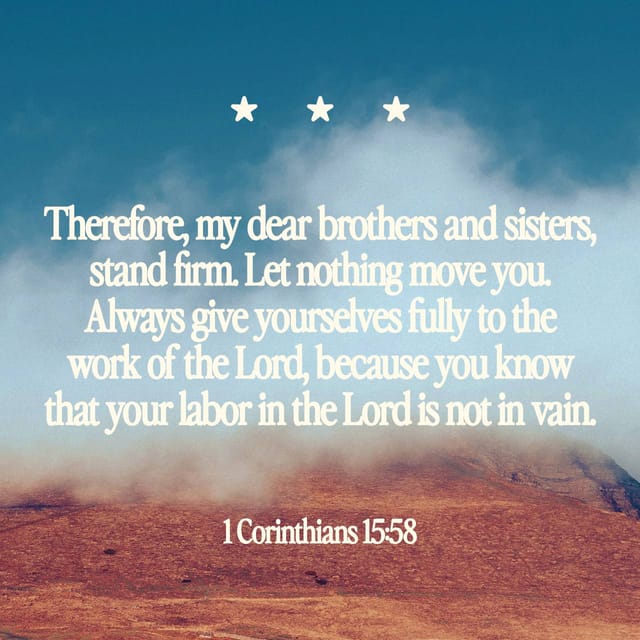
Therefore, my beloved brothers, be steadfast, immovable, always abounding in the Lord's work, because you know that your labor is not in vain in the Lord.
1 Corinthians 15:58
Historical lead-up
In 1 Corinthians 15, Paul addresses questions and confusion about the resurrection. He reminds the church that Jesus truly rose from the dead and explains why the resurrection gives believers hope beyond death. Near the end of the chapter, he describes the victory God gives through Jesus and turns that hope toward faithful living.
Why this verse was written
Paul wrote to the Christians in Corinth, a church facing disagreements and challenges in its life together. After teaching about the resurrection, he encourages them not to treat their faith or service as pointless. Their future hope is meant to strengthen their faithfulness now.
True meaning
Paul is urging believers to remain steady in their trust and to keep giving themselves to the work of serving the Lord. “Always abounding” points to a willing, generous readiness to do good—not a demand to exhaust ourselves or prove our worth. The reason for this encouragement is that service offered to the Lord is not wasted. In the context of the chapter, resurrection hope gives meaning to faithful work even when its results are not immediately visible.
Living it today
Choose one ordinary act of faithfulness today: encourage someone, fulfill a responsibility with care, serve quietly, or keep praying through a difficult season. When discouragement comes, remember that God sees work done in love, even when others do not notice it. This verse is not a call to ignore limits; rest, wise boundaries, and asking for help can also be part of faithful living. Pray for strength and talk with a trusted person in your group about where you need encouragement.
What follows
This verse closes Paul’s teaching on the resurrection by connecting Christian hope with steadfast service. It leaves the church with a practical response: live faithfully because the risen Lord makes that faithfulness meaningful.
Related: John 1:14 — King James Version (KJV) (2026-08-22)
Related: John 1:14 — Young’s Literal Translation (YLT) (2026-08-22)
Go deeper with a Verse Study Card — plain words, context, key words, cross-references, and a reflection.
Study this verse
Plain words, context, key words, cross-references, and one reflection question for a single verse.