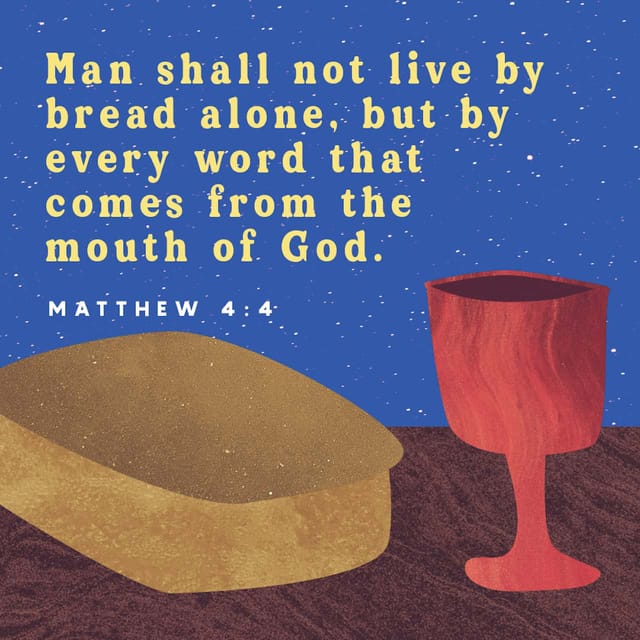
But he answered, "It is written, 'Man shall not live by bread alone, but by every word that proceeds out of the mouth of God.'"
Matthew 4:4
Historical lead-up
Matthew places this verse during Jesus’ time in the wilderness, after his baptism and before he begins his public ministry. He is fasting and facing temptation. The setting recalls Israel’s wilderness years, when God’s people learned to depend on him.
Why this verse was written
Matthew tells this story to show how Jesus responds faithfully when tested. The Gospel presents Jesus as the Son who trusts and obeys God, even under pressure. In this moment, Jesus answers a temptation by pointing to God’s teaching in Scripture.
True meaning
Jesus is speaking to the tempter, and his answer makes clear that physical food is not the only thing people need. Human life depends ultimately on God and on what God says. This does not mean bodily needs are unimportant; it means they are not our deepest source of life, and meeting them should not lead us away from trusting God.
Living it today
When pressure, fear, or a strong desire makes a quick solution seem necessary, pause and ask what faithfulness to God looks like. Make room for Scripture, prayer, and wise counsel as you decide. In relationships, seek to meet real needs with care while refusing to treat comfort, approval, or success as more important than obedience and love. Consider discussing with your group where it is hardest to trust God’s guidance.
What follows
Jesus continues to face temptations that challenge his trust in God. The passage shows him answering each one with faithful reliance on God rather than using his power for self-serving ends.
Related: John 1:14 — Young’s Literal Translation (YLT) (2026-08-22)
Related: John 1:14 — King James Version (KJV) (2026-08-22)
Go deeper with a Verse Study Card — plain words, context, key words, cross-references, and a reflection.
Study this verse
Plain words, context, key words, cross-references, and one reflection question for a single verse.