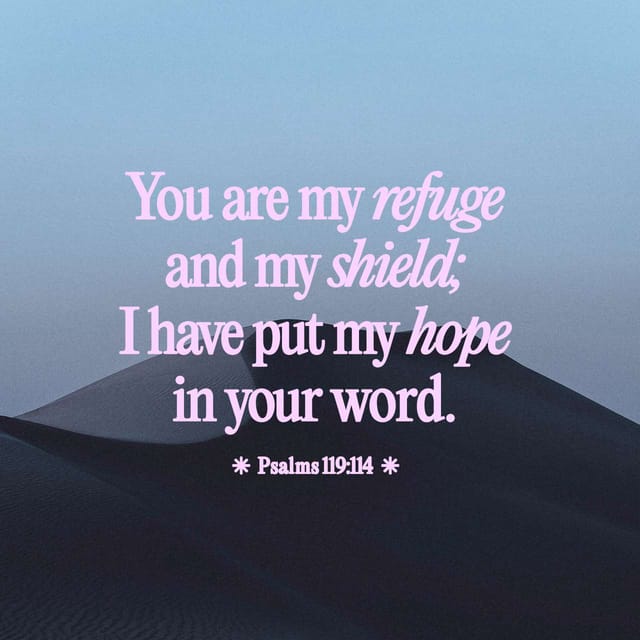
Thou art my hiding-place and my shield: I hope in thy word.
Psalms 119:114
Historical lead-up
Psalm 119 is a long prayer celebrating God’s instruction and the life it gives. In this part of the psalm, the writer speaks amid trouble and opposition, turning to God’s word for direction and steadiness.
Why this verse was written
The psalmist writes to express trust in God and to encourage faithful attention to God’s teaching. This verse is a personal confession of where the writer seeks safety and what sustains hope.
True meaning
The psalmist addresses God directly. Calling God a “hiding-place” pictures a refuge in danger; calling God a “shield” pictures protection. “I hope in thy word” means the writer relies on what God has said and looks to it with expectation. The verse does not promise a trouble-free life; it shows where the writer turns while facing trouble.
Living it today
When you feel exposed, anxious, or pressured, you can bring that honestly to God in prayer and seek guidance in Scripture. Let trust shape practical choices too: step away from influences that pull you toward harm, and ask God for help to act with patience, courage, and care toward others. Consider discussing with your group what it looks like to find refuge in God without pretending that difficulties are easy.
What follows
The next verses connect hope with faithful action. The psalmist asks God to uphold and sustain him, turns away from evildoers so he can observe God’s commandments, and asks not to be ashamed of his hope. Together, these thoughts show that trusting God includes seeking strength to keep living faithfully. You might pray for help to hold to what is good, especially when doing so feels difficult.
Related: John 1:14 — Young’s Literal Translation (YLT) (2026-08-22)
Related: John 1:14 — King James Version (KJV) (2026-08-22)
Go deeper with a Verse Study Card — plain words, context, key words, cross-references, and a reflection.
Study this verse
Plain words, context, key words, cross-references, and one reflection question for a single verse.