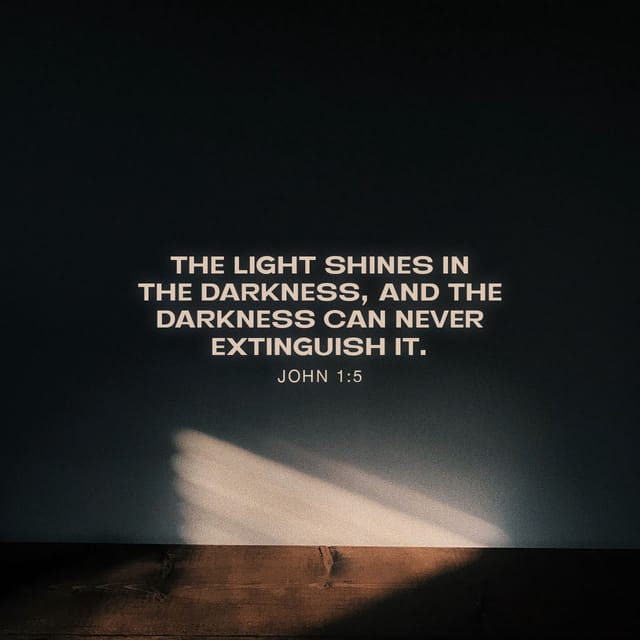
and the light in the darkness did shine, and the darkness did not perceive it.
John 1:5
Historical lead-up
John’s Gospel opens by describing the Word as present with God from the beginning and as the source of life. It then uses the image of light shining in darkness. John 1:5 continues that picture, introducing a contrast between the light and the darkness.
Why this verse was written
John wrote his Gospel to bear witness to Jesus and help readers believe in him. In these opening lines, he presents Jesus as the life and light humanity needs. The verse prepares readers to see that the light’s coming meets resistance and misunderstanding.
True meaning
The “light” points to the life and truth revealed in Jesus; “darkness” describes the world’s opposition to, or failure to recognize, that light. The verse says the light shone in the darkness, but the darkness did not “perceive” it—that is, it did not grasp or overcome it. The image holds both the reality of resistance and the persistence of the light.
Living it today
When confusion, fear, or wrongdoing feels powerful, this verse can remind us not to assume that darkness has the final word. We can seek Jesus’ truth in Scripture, pray for wisdom, and choose honesty, mercy, and courage in ordinary decisions. In relationships, we can bear witness to the light through patient listening and faithful actions rather than trying to force belief. Consider discussing with your group where you need hope or clearer guidance, and pray together about it.
What follows
The next verses introduce John, a man sent by God to testify about the Light so that people might believe through his witness. They also make clear that John himself was not the Light; his role was to point to it. Today, we can follow that pattern by directing attention toward Jesus rather than making ourselves the center of our witness.
Related: John 1:14 — Young’s Literal Translation (YLT) (2026-08-22)
Related: John 1:14 — King James Version (KJV) (2026-08-22)
Go deeper with a Verse Study Card — plain words, context, key words, cross-references, and a reflection.
Study this verse
Plain words, context, key words, cross-references, and one reflection question for a single verse.