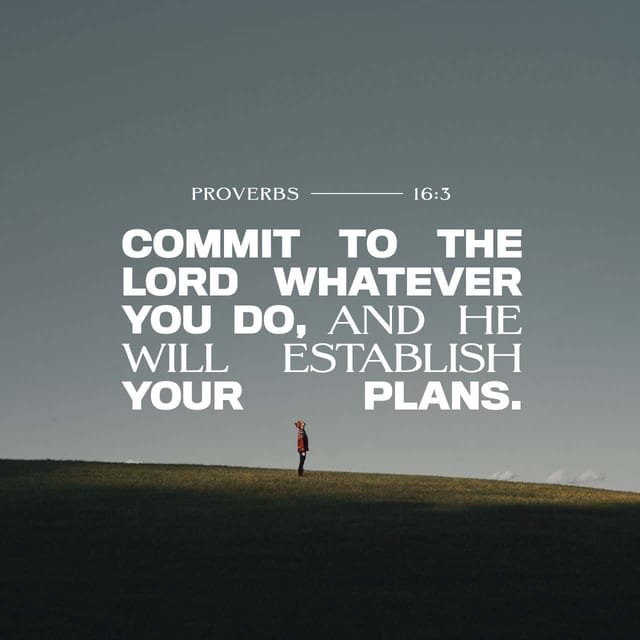
Commit your deeds to Yahweh, and your plans shall succeed.
Proverbs 16:3
Historical lead-up
Proverbs gathers wisdom for living faithfully in everyday life. Proverbs 16 reflects on human plans and choices while reminding readers that God sees and directs more than we can. Its sayings invite us to seek wisdom rather than rely only on our own judgment.
Why this verse was written
This proverb was written to teach people how to approach their work and plans with trust in God. It is a short piece of wisdom, not a promise that every project will succeed exactly as we hope. It encourages a life in which our efforts are brought under God’s care and guidance.
True meaning
The verse speaks to people making plans and doing their work. To commit something to the Lord means entrusting it to God and seeking to act in a way that honors him. The promise of established plans points to God’s guidance and steadiness; it does not mean that prayer guarantees our preferred outcome. We remain responsible to plan wisely, work faithfully, and be willing to change course.
Living it today
Before beginning a task or making a decision, pause to pray and ask whether your motives and methods reflect love, honesty, and care for others. Make a practical plan, then hold it with humility. Invite wise counsel, listen when circumstances reveal a need to adjust, and entrust the outcome to God. In relationships, this can mean seeking understanding rather than trying to control another person. In a small group, consider sharing one plan you want to place in God’s hands and praying for wisdom together.
What follows
The surrounding verses continue reflecting on human plans, choices, and God’s rule. They encourage humility: we can make plans, but we should not assume that we see the whole picture.
Related: John 1:14 — Young’s Literal Translation (YLT) (2026-08-22)
Related: John 1:14 — King James Version (KJV) (2026-08-22)
Go deeper with a Verse Study Card — plain words, context, key words, cross-references, and a reflection.
Study this verse
Plain words, context, key words, cross-references, and one reflection question for a single verse.