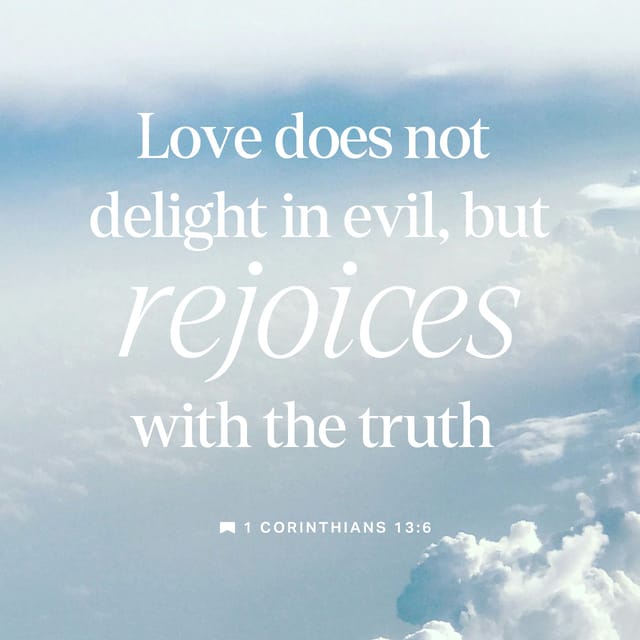
doesn't rejoice in unrighteousness, but rejoices with the truth;
1 Corinthians 13:6
Historical lead-up
In 1 Corinthians 12–14, Paul addresses a church with many spiritual gifts and explains how those gifts should serve the whole community. He places his teaching about love between guidance on spiritual gifts, showing that gifts are not a substitute for loving one another. The surrounding chapter describes love’s character and contrasts it with selfish or harmful ways of treating others.
Why this verse was written
Paul wrote to the Christians in Corinth to help them grow in unity and maturity. His teaching reminds them that love must shape how they use their abilities and respond to one another. The verse is part of a larger description of what love does and does not welcome.
True meaning
Paul is describing love as something that does not take pleasure in wrongdoing. Instead, love is glad when what is true comes to light and is honored. This is not permission to gloat over someone’s failure or to use “truth” as a weapon. In context, love seeks what is good and truthful rather than what harms or deceives.
Living it today
In daily life, this can mean refusing to spread gossip, celebrate another person’s embarrassment, or excuse dishonesty because it benefits us. It also means welcoming honest conversations with humility and care. Ask God to help you speak truth gently, listen without defensiveness, and rejoice when people choose what is right. In a small group, consider how your words can build trust rather than shame.
What follows
Paul continues describing love as patient and enduring, then turns back to how the church should understand spiritual gifts. The larger passage keeps pointing the community toward love as the way that gives their service its proper shape.
Related: John 1:14 — King James Version (KJV) (2026-08-22)
Related: John 1:14 — Young’s Literal Translation (YLT) (2026-08-22)
Go deeper with a Verse Study Card — plain words, context, key words, cross-references, and a reflection.
Study this verse
Plain words, context, key words, cross-references, and one reflection question for a single verse.