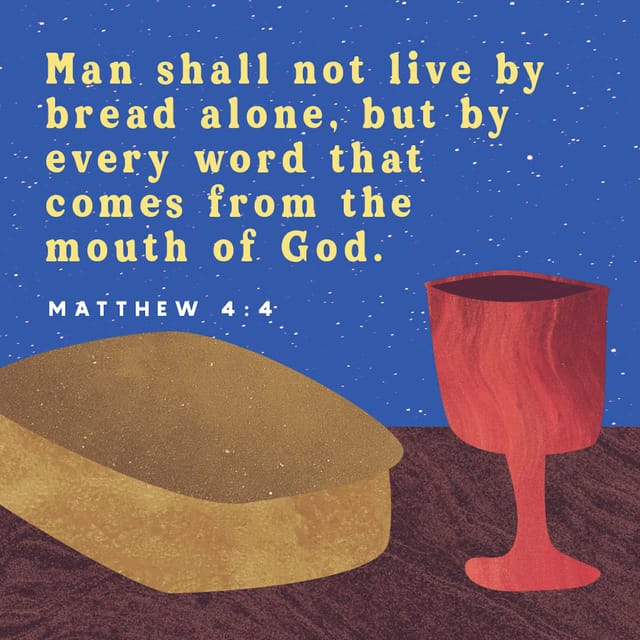
But he answered, "It is written, 'Man shall not live by bread alone, but by every word that proceeds out of the mouth of God.'"
Matthew 4:4
Historical lead-up
Matthew places this verse during Jesus’ time in the wilderness, after his baptism and before he begins his public ministry. He has been fasting, and the tempter challenges him to use his power to satisfy his hunger. Jesus answers by turning to Scripture.
Why this verse was written
Matthew presents Jesus as faithful to God while facing testing. For readers of the Gospel, this moment shows that Jesus’ choices are guided by trust and obedience to God, not merely by immediate need or pressure.
True meaning
Jesus is speaking to the tempter, and his answer draws on Israel’s Scriptures. The point is not that physical food is unimportant: Jesus is genuinely hungry. Rather, human life depends on God, and God’s word and will matter more than satisfying a desire in a way that turns away from him. Jesus refuses to treat his power as a reason to distrust or disobey God.
Living it today
When you feel pressured, pause and ask what faithfulness looks like—not only what would bring quick relief. Make room for Scripture and prayer in ordinary routines, and seek wise support when a decision feels difficult. In relationships, this can mean choosing honesty, patience, and care over the easiest response. Discuss together: What helps you remember God’s guidance when you feel tested?
What follows
The tempter continues to test Jesus, and Jesus continues to answer with trust in God’s word. The passage shows that faithfulness is not a one-time choice but a steady reliance on God through pressure.
Related: John 1:14 — King James Version (KJV) (2026-08-22)
Related: John 1:14 — Young’s Literal Translation (YLT) (2026-08-22)
Go deeper with a Verse Study Card — plain words, context, key words, cross-references, and a reflection.
Study this verse
Plain words, context, key words, cross-references, and one reflection question for a single verse.