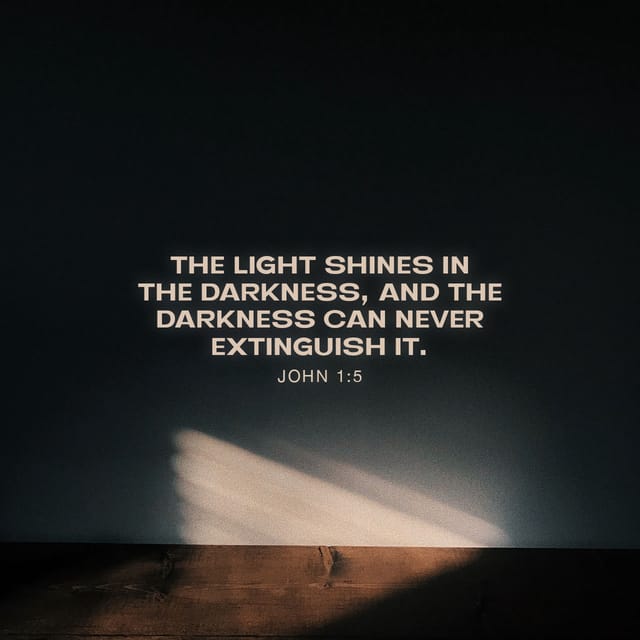
And the light shines in the darkness, and the darkness did not comprehend it.
John 1:5
Historical lead-up
John’s Gospel opens by describing the Word as present with God from the beginning and as the source of life. It then uses the image of light shining in darkness to introduce the hope and revelation that come through him.
Why this verse was written
John wrote his Gospel to bear witness to Jesus and help readers believe. This verse belongs to the opening picture of who Jesus is and what his coming means: God’s light is present even where darkness seems to prevail.
True meaning
The “light” points to the life and revelation found in the Word, whom the Gospel later identifies with Jesus. “Darkness” represents what opposes or fails to receive that light. The phrase “did not comprehend it” can carry the sense of not grasping or overcoming it. The verse therefore holds together both the darkness’s failure to understand the light and its inability to extinguish it.
Living it today
When life feels confusing or heavy, this verse invites us to seek God’s light rather than assume darkness has the final word. We can practice that by praying honestly, turning to Scripture, and choosing truth, kindness, and faithfulness in our relationships. We can also ask trusted people in our church community to walk with us as we discern a next step.
What follows
The next verses introduce John, sent by God as a witness to the Light. They make clear that John was not the Light himself; his role was to point others toward it so they might believe. Today, we can follow that example humbly: we do not need to be the source of hope, but we can point others toward God through our words and actions.
Related: John 1:14 — Catholic Public Domain Version (CPDV) (2026-08-22)
Related: John 1:14 — Young’s Literal Translation (YLT) (2026-08-22)
Go deeper with a Verse Study Card — plain words, context, key words, cross-references, and a reflection.
Study this verse
Plain words, context, key words, cross-references, and one reflection question for a single verse.